
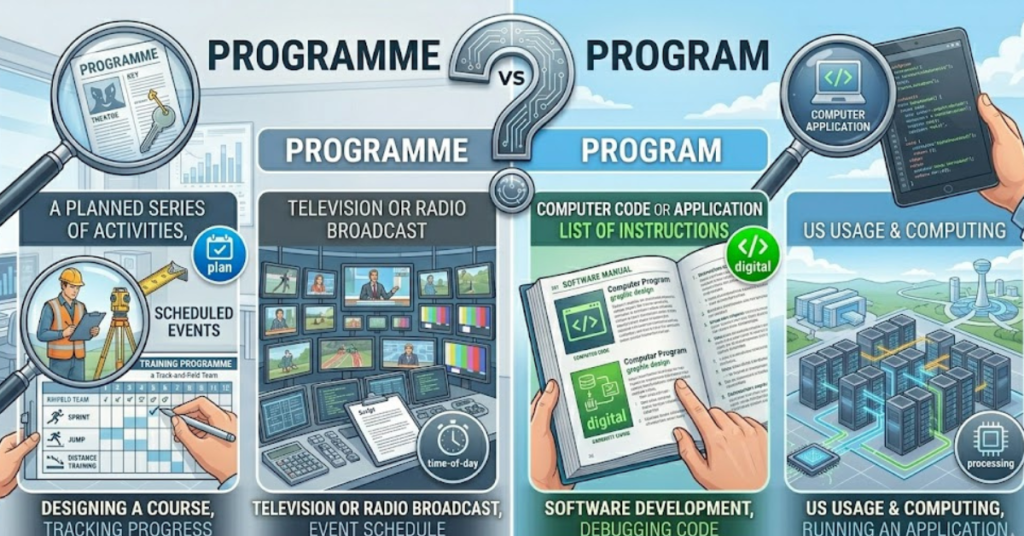
English spelling can be surprisingly confusing, especially when the same word changes depending on the country. One of the most common examples is programme vs program. If you’ve ever wondered which spelling is correct, you’re not alone.
The answer depends largely on where the English is being used and the context in which the word appears. In some countries, both spellings exist side by side, while in others, one version dominates almost completely.
In this guide, we’ll explore the meanings, regional spelling rules, usage examples, academic applications, and historical background behind these two commonly debated spellings.
What Does “Program” Mean?
The word “program” generally refers to:
- A planned series of activities
- A schedule or agenda
- A software application
- A broadcast show
- A structured course or system
Examples of “Program” in Sentences
- I installed a new editing program on my laptop.
- The university launched a business training program.
- We watched a television program about wildlife.
In American English, this spelling is used almost everywhere.
What Does “Programme” Mean?
“Programme” carries the same basic meaning but is traditionally used in British English and several other Commonwealth countries.
Examples of “Programme” in Sentences
- The theatre programme listed all the performers.
- She enrolled in a graduate programme at university.
- The government introduced a healthcare programme.
The meaning does not change significantly; the spelling does.
Programme vs Program: The Main Difference
The biggest distinction is regional spelling preference.
“Program” Is Common In:
- United States
- American English writing
- Computer and software terminology worldwide
“Programme” Is Common In:
- United Kingdom
- Australia
- New Zealand
- South Africa
- Some Canadian contexts
So the difference is mostly about language style rather than meaning.
British English Spelling: Programme vs Program
In traditional British English, “programme” is the preferred spelling for most general uses.
Common British Usage
- TV programme
- Educational programme
- Event programme
- Training programme
However, British English usually switches to “program” when discussing computers or coding.
Example
- He wrote a computer program for data analysis.
This mixed usage sometimes surprises English learners.
American English Usage
American English strongly prefers “program” in nearly all situations.
That includes:
- Television program
- School program
- Computer program
- Government program
In the United States, “programme” is considered uncommon and often appears old-fashioned or overly formal.
Programme vs Program UK Usage
In the UK, both spellings exist, but context matters.
British Writing Rules
Use “programme” for:
- Events
- Educational courses
- TV schedules
- Public initiatives
Use “program” for:
- Software
- Coding
- Computer systems
This distinction remains standard across much of British publishing and media.
Australian and New Zealand English Spelling
Australian and New Zealand English generally follow British spelling conventions.
In Australia and New Zealand
You’ll commonly see:
- University programme
- Festival programme
- Government programme
But technology-related writing often uses “program,” especially in IT industries.
This creates a blend of British tradition and modern global tech language.
Programme vs Program in College and Education
Educational institutions often prefer different spellings depending on location.
In the United States
Colleges usually write:
- Degree program
- Academic program
- Scholarship program
In the UK and Commonwealth Countries
Universities commonly write:
- Degree programme
- Study programme
- Research programme
The meaning stays the same despite the spelling difference.
Programme vs Program for Events
Event organizers also follow regional spelling styles.
American Event Usage
- Event program
- Concert program
- Sports program
British Event Usage
- Event programme
- Theatre programme
- Ceremony programme
Printed event schedules in the UK almost always use the longer spelling.
Why Do Both Spellings Exist?
The word originally came from Greek and later entered English through French and Latin influences.
Over time:
- American English simplified many spellings.
- British English retained more traditional forms.
This pattern appears in many other word pairs, including:
- Colour vs color
- Centre vs center
- Theatre vs theater
The spelling variation reflects historical language evolution rather than grammatical correctness.
Programme vs Program Meaning in Hindi
For Hindi speakers, both words generally translate similarly depending on context.
Possible meanings include:
- कार्यक्रम
- योजना
- पाठ्यक्रम
- सॉफ्टवेयर प्रोग्राम
The difference lies more in English spelling conventions than in translation.
Spelling of Programme vs Program in Technology
One interesting exception exists worldwide.
Even in countries that prefer “programme,” the technology industry almost always uses “program” for computing.
Examples
- Computer program
- Programming language
- Software program
This Americanized spelling became dominant because of the global influence of the tech industry.
Common Mistakes People Make
Here are some examples of incorrect or inconsistent usage.
Incorrect
- She wrote a software programme for the company.
(acceptable in some regions, but less standard in tech writing) - The college launched a new degree program in London.
(may sound American in British contexts)
Better Context-Based Usage
- She wrote a software program for the company.
- The college launched a new degree programme in London.
Consistency matters more than strict universal rules.
Easy Memory Tricks
Simple associations can help you remember which spelling to use.
Remember “Programme” for British Style
The extra “me” at the end reflects the longer traditional British spelling style.
Remember “Program” for Simplicity
American English often favors shorter spellings.
How to Choose the Correct Spelling
The best choice depends on your audience.
Use “Program” If:
- Writing for American readers
- Discussing software or coding
- Following US style guides
Use “Programme” If:
- Writing in British English
- Creating UK academic or event materials
- Following Commonwealth spelling conventions
Consistency throughout your writing is the most important rule.
Frequently Asked Questions
What is the difference between programme and program?
The difference is mainly regional spelling. “Programme” is common in British English, while “program” is standard in American English.
Which spelling is correct in the UK?
In the UK, “programme” is used for most general meanings, but “program” is usually preferred for computer-related contexts.
Is “programme” wrong in America?
Not technically, but it’s uncommon in American English and may appear overly formal or foreign.
Why does computer language use “program” worldwide?
The global tech industry was heavily influenced by American English, making “program” the dominant computing spelling internationally.
Which spelling does Australia use?
Australian English generally follows British conventions and often prefers “programme” outside computing contexts.
Can I use both spellings in the same article?
It’s better to stay consistent with one style unless discussing regional differences directly.
Conclusion
The debate around programme vs program is really about regional English preferences rather than right versus wrong spelling.
Here’s the simplest way to remember it:
- Program is standard in American English and computing.
- Programme is traditional in British and Commonwealth English for general usage.
Understanding these distinctions helps your writing appear more polished, professional, and culturally appropriate for your audience. Whether you’re writing academic content, event materials, software documentation, or business communication, choosing the right spelling improves clarity and consistency.
If you enjoy learning about English spelling differences, explore more grammar and vocabulary guides to strengthen your writing skills even further.