
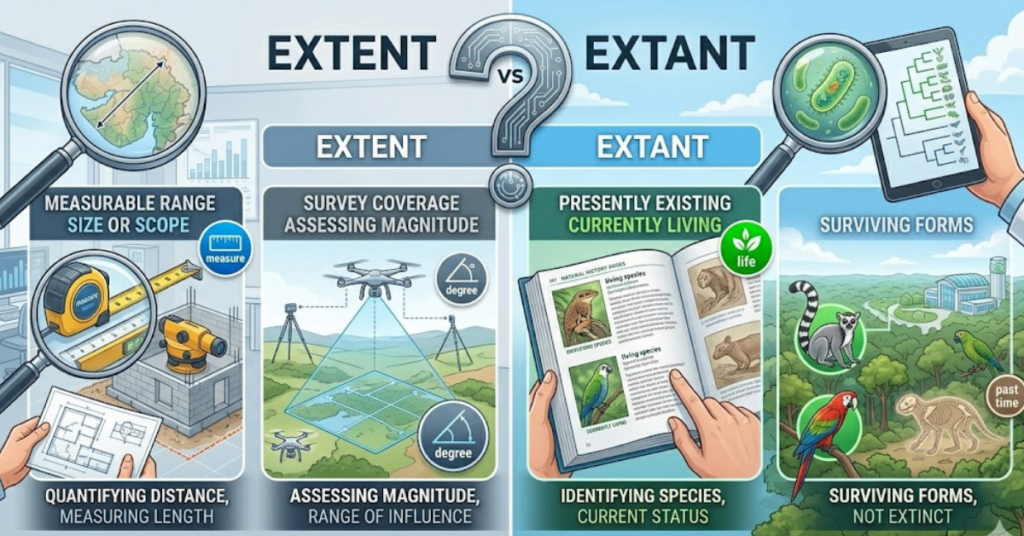
English has plenty of word pairs that look almost identical but mean completely different things. One of the most confusing examples is extent vs extant. Since these words differ by just one letter, many writers accidentally swap them without realizing it.
The confusion becomes even more common in academic writing, professional communication, literature, and research papers where both terms may appear. But despite their similar appearance, they are not interchangeable at all.
In this guide, you’ll learn the meanings, pronunciation, grammar usage, examples, and memory tricks that make these two words much easier to understand and use correctly.
What Does “Extent” Mean?
The word “extent” refers to the size, degree, range, or scope of something. It is commonly used when discussing how much, how far, or how serious something is.
Common Uses of “Extent”
People often use this word when talking about:
- Damage
- Influence
- Knowledge
- Growth
- Impact
- Area or coverage
Examples of “Extent” in Sentences
- We don’t yet know the full extent of the damage.
- She understood the extent of the problem immediately.
- The survey measured the extent of customer satisfaction.
In each case, the word relates to degree, amount, or scope.
What Does “Extant” Mean?
“Extant” means still existing, surviving, or currently in existence. It is usually used in formal, academic, historical, or scientific contexts.
Common Uses of “Extant”
This word often appears when discussing:
- Ancient texts
- Historical documents
- Species
- Artifacts
- Literature
- Records
Examples of “Extant” in Sentences
- Only a few extant copies of the manuscript remain.
- The museum contains extant artifacts from the Roman Empire.
- Researchers studied the oldest extant version of the text.
Here, the word refers to something that still survives or exists today.
Extent vs Extant: The Core Difference
The easiest way to separate these words is this:
- Extent = degree or scope
- Extant = still existing
One measures how much something exists, while the other confirms that something still exists at all.
That distinction makes the meanings much easier to remember.
Why These Words Are Commonly Confused
There are several reasons people mix these terms up.
Nearly Identical Spelling
Only one letter changes between the two words, making them visually confusing.
Similar Pronunciation
In some accents, the words sound extremely close in casual speech.
Formal Vocabulary
Neither word appears frequently in everyday conversation, so many people encounter them mainly in books or academic writing.
How “Extent” Is Used in Everyday English
“Extent” is far more common in daily communication than “extant.”
You’ll hear it in phrases like:
- To a certain extent
- Full extent
- Extent of the damage
- Extent of the law
Example Phrases
- I agree to some extent.
- The authorities investigated the full extent of the issue.
- Nobody realized the extent of the crisis.
Because it’s widely used, most people recognize it immediately.
How “Extant” Is Used in Academic Writing
“Extant” tends to appear in more specialized contexts.
Common Academic Fields Using “Extant”
- History
- Archaeology
- Literature
- Biology
- Linguistics
- Theology
Example Usage
- Scholars compared extant versions of the poem.
- Few extant records survive from that period.
It’s considered a more formal and less common word.
Easy Memory Tricks
Simple associations can help you remember the difference quickly.
Remember “Extent” With “Expansion”
Both words relate to size, range, or amount.
Remember “Extant” With “Exist”
The word “extant” contains a sound similar to “exist,” which helps remind you that it means still existing.
These little mental shortcuts are surprisingly effective.
Common Mistakes to Avoid
Here are some incorrect examples that show how confusion happens.
Incorrect
- Historians studied the extent manuscripts.
- We don’t know the extant of the damage.
Correct
- Historians studied the extant manuscripts.
- We don’t know the extent of the damage.
One word refers to surviving objects, while the other refers to degree or scope.
Extent vs Extant in Professional Writing
Using the wrong word in formal writing can make sentences confusing or inaccurate.
For example:
- “The extant of the wildfire” sounds incorrect because the sentence discusses size or severity.
- “The extent documents” also sounds wrong because documents are being described as surviving.
Precise vocabulary improves clarity and professionalism.
Pronunciation Differences
Although the words look similar, pronunciation differs slightly.
- Extent is pronounced with emphasis on the second syllable.
- Extant usually has a flatter ending sound.
Still, many speakers pronounce them similarly enough that spelling mistakes remain common.
Synonyms for “Extent”
Understanding related words can strengthen vocabulary.
Similar Words
- Degree
- Scope
- Range
- Magnitude
- Scale
- Reach
These all relate to size or amount.
Synonyms for “Extant”
Here are words similar in meaning to “extant.”
Similar Words
- Existing
- Surviving
- Remaining
- Living
- Preserved
- Current
These terms all involve continued existence.
Tips for Using These Words Correctly
If you struggle with confusing vocabulary, these techniques can help.
- Focus on sentence meaning, not pronunciation.
- Ask whether the sentence refers to “amount” or “existence.”
- Practice writing your own examples.
- Read academic and professional content carefully.
- Proofread slowly before publishing.
Over time, the distinction becomes automatic.
Why Correct Word Choice Matters
Words that look similar can create major misunderstandings when used incorrectly.
In academic or professional settings, precise vocabulary matters because readers expect clarity and accuracy. A single incorrect word may weaken credibility or confuse the intended message.
Learning nuanced vocabulary pairs like these improves both writing confidence and communication skills.
Frequently Asked Questions
What is the difference between extent and extant?
“Extent” refers to the degree or scope of something, while “extant” means still existing or surviving.
Is extant a commonly used word?
Not in everyday conversation. It appears more often in academic, historical, and literary contexts.
Can extent and extant be used interchangeably?
No. Even though they look similar, their meanings are completely different.
What does extant mean in history?
In historical writing, “extant” refers to documents, artifacts, or records that still survive today.
What does extent mean in simple words?
It means the size, amount, or seriousness of something.
Why do people confuse these words?
People confuse them because they differ by only one letter and have somewhat similar pronunciation.
Conclusion
The confusion around extent vs extant is understandable, especially because the words look nearly identical. But once you understand their meanings, the difference becomes much clearer.
Remember:
- Extent refers to degree, size, or scope.
- Extant refers to something that still exists.
That one distinction can help you avoid mistakes in academic papers, professional communication, and everyday writing. The more you practice using these words in context, the more natural they’ll feel.
If you enjoy improving your vocabulary and grammar skills, keep exploring other commonly confused word pairs to sharpen your English even further.