
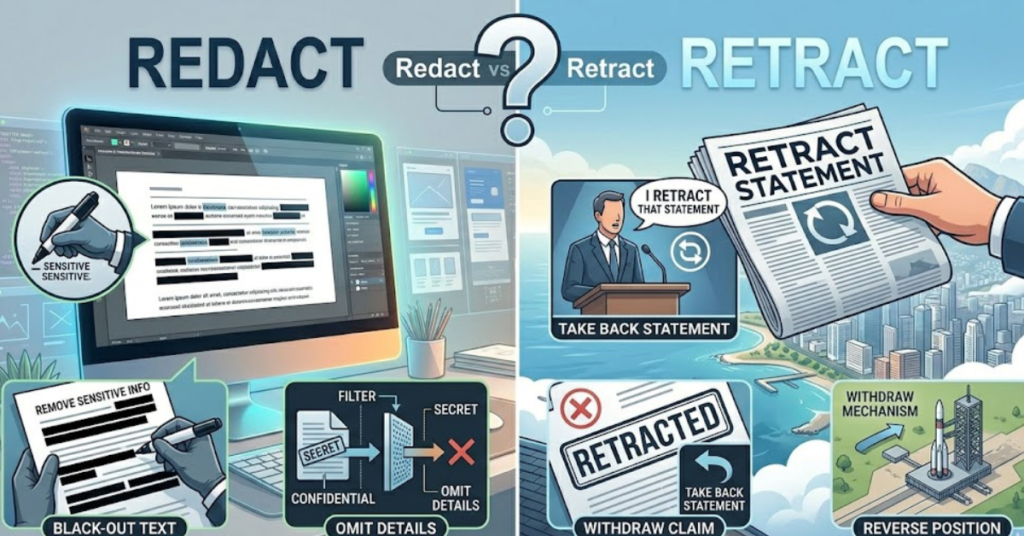
English is full of words that look similar but carry completely different meanings. One pair that often causes confusion is redact vs retract. At first glance, they seem closely related because they share similar spelling and pronunciation patterns. But in reality, these words are used in very different situations.
Understanding the distinction matters, especially in legal writing, journalism, publishing, academic work, and professional communication. Using the wrong term can completely change the meaning of a sentence.
In this guide, we’ll break down the meanings, origins, examples, and practical usage of both words in a way that’s easy to remember and apply in everyday writing.
What Does “Redact” Mean?
The word “redact” means to edit, prepare, or censor written material before publication or release. In modern usage, it often refers to removing sensitive or confidential information from documents.
People commonly use this term in:
- Legal documents
- Government files
- Medical records
- Journalism
- Business reports
Examples of “Redact” in Sentences
- The lawyer redacted personal information from the contract.
- Sensitive data was redacted before the report became public.
- Journalists sometimes redact names to protect sources.
Common Contexts for Redaction
Redaction is important when privacy or security is involved. Information often removed includes:
- Phone numbers
- Addresses
- Financial details
- Social security numbers
- Classified information
In many cases, the hidden text appears as black bars or blank spaces in documents.
What Does “Retract” Mean?
“Retract” means to withdraw, take back, or reverse a statement, opinion, or accusation. It can also refer to pulling something inward physically.
This word is frequently used in:
- News reporting
- Public statements
- Scientific publications
- Apologies
- Mechanical or biological contexts
Examples of “Retract” in Sentences
- The newspaper retracted the false claim.
- He later retracted his statement during the interview.
- A turtle retracts its head into its shell for protection.
Common Situations Where Retraction Happens
Retractions often occur when:
- Incorrect information was published.
- A person regrets a statement.
- Research findings are proven inaccurate.
- Legal pressure requires correction.
In journalism and academia, retractions are taken very seriously because credibility is involved.
Redact vs Retract: The Core Difference
The easiest way to remember the difference is this:
- Redact = edit or hide information
- Retract = take something back
One deals with modifying content, while the other involves reversing a statement or action.
Although both words appear in formal writing, they serve completely different purposes.
Why People Confuse These Words
There are several reasons why these terms are commonly mixed up.
Similar Spelling
Both words begin with “re” and end with “act,” making them visually similar.
Professional Usage
You’ll often encounter both terms in legal, media, and corporate environments, which adds to the confusion.
Formal Tone
Because neither word is commonly used in casual conversation, many people learn them only through reading or workplace communication.
The Origin of the Words
Understanding word origins can make them easier to remember.
Origin of “Redact”
“Redact” comes from the Latin word redigere, meaning “to bring together” or “arrange.” Over time, it evolved into a term connected with editing and preparing written material.
Origin of “Retract”
“Retract” comes from the Latin retrahere, meaning “to draw back.” That meaning still exists today when someone withdraws a statement or pulls something inward.
Legal and Professional Usage
Both words appear frequently in professional environments, but in different ways.
In Law
Lawyers often redact documents before sharing them publicly to protect confidential details.
A retraction, on the other hand, may happen if someone withdraws an accusation or published claim.
In Journalism
News organizations redact sensitive information when releasing court records or investigative materials.
They issue retractions when published information turns out to be false or misleading.
In Academic Publishing
Researchers may retract a scientific paper if serious errors or ethical issues are discovered after publication.
Common Mistakes to Avoid
Here are some examples of incorrect usage and their corrected forms.
Incorrect
- The company retracted all customer names from the file.
- The editor redacted the false statement from yesterday’s article.
Correct
- The company redacted all customer names from the file.
- The editor retracted the false statement from yesterday’s article.
The first sentence involves hiding information, while the second involves taking back a claim.
Simple Memory Tricks
Sometimes a small association helps words stick instantly.
Remember “Redact” With Documents
Think of the blacked-out text you see in classified files. That’s redaction.
Remember “Retract” With Reverse
The word “retract” involves reversing or withdrawing something previously said or done.
Synonyms for Each Word
Learning similar words can deepen understanding.
Synonyms for “Redact”
- Edit
- Censor
- Prepare
- Revise
- Black out
Synonyms for “Retract”
- Withdraw
- Reverse
- Take back
- Recant
- Cancel
Even though some synonyms overlap slightly in tone, the meanings remain distinct.
How to Use These Words Correctly in Writing
Here are a few practical tips to avoid confusion.
- Ask whether information is being hidden or withdrawn.
- Think about the context: documents or statements.
- Proofread formal writing carefully.
- Pay attention to legal and journalistic usage.
- Practice using both words in sample sentences.
With repetition, the difference becomes natural.
Why Correct Usage Matters
Using the wrong word can affect clarity and professionalism.
Imagine a headline saying:
- “Government retracts classified information”
That sounds incorrect because information is usually redacted, not retracted.
Precise word choice improves communication and helps readers trust your writing.
Frequently Asked Questions
What is the main difference between redact and retract?
“Redact” means to edit or hide sensitive information, while “retract” means to withdraw or take back a statement.
Can a document be retracted?
Yes, but it depends on context. A publication or report can be formally withdrawn, but hidden information inside a document is usually redacted.
What does redacted mean in legal documents?
It means sensitive or confidential information has been removed or hidden before sharing the document.
Why do newspapers issue retractions?
Newspapers retract information when published claims are inaccurate, misleading, or false.
Is retract the opposite of publish?
Not exactly, but retracting often happens after something has already been published or announced publicly.
Can a person retract a statement?
Yes. People retract statements when they want to withdraw or correct something they previously said.
Conclusion
The confusion around redact vs retract is understandable because the words look and sound somewhat alike. But their meanings are very different once you break them down clearly.
Remember the key distinction:
- Redact relates to editing or hiding information.
- Retract relates to withdrawing or taking something back.
Whether you’re writing legal content, editing documents, publishing articles, or simply improving your English vocabulary, knowing the correct usage helps you communicate more accurately and professionally.
If you enjoy learning about confusing English words, explore more grammar and vocabulary guides to strengthen your writing skills even further.