
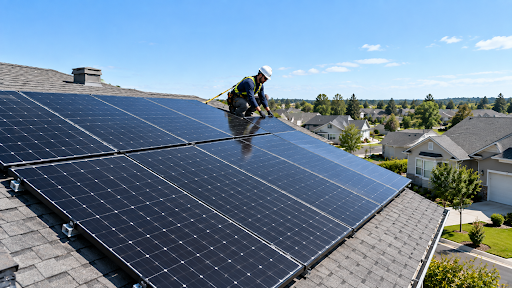
Solar panel efficiency has climbed faster in the last five years than in the previous fifteen combined. Panels that topped out around 20 percent efficiency a decade ago have given way to commercial modules now crossing 24 and even 25 percent, thanks to cell designs that would have sounded experimental not long ago.
For anyone shopping for solar in 2026, that shift matters in a very practical way. High-efficiency photovoltaic modules let you generate more electricity from a smaller roof or a tighter commercial rooftop footprint, which changes the math on projects that were previously space-constrained. But the module is only half the system. Pair the wrong inverter with a great panel, and you leave real performance on the table.
This guide covers what actually makes a photovoltaic module high efficiency, which technologies and brands lead the market right now, and how to choose the hybrid solar inverter that lets that efficiency translate into real savings and backup power.
What Makes a Photovoltaic Module High Efficiency
Module efficiency measures what percentage of sunlight hitting the panel actually converts into usable electricity. A 400-watt panel rated at 20 percent efficiency and one rated at 24 percent efficiency can produce the same power output, but the more efficient panel does it in a smaller physical footprint.
That difference sounds small on paper but adds up fast. A roof that fits twenty standard-efficiency panels might fit twenty-four high-efficiency panels of the same physical size, translating directly into more system capacity without adding a single square foot of roof space.
Efficiency gains over the past several years have come almost entirely from changes at the solar cell level, not from bigger panels or thicker glass. Understanding those cell technologies explains why some brands consistently top the efficiency charts.
Solar Cell Technologies Behind Today’s Highest Efficiency Panels
TOPCon Cells
TOPCon, short for tunnel oxide passivated contact, has become the mainstream upgrade path from older PERC cell technology. It adds a thin passivation layer that reduces electron recombination losses, pushing commercial module efficiency past 24 percent for leading manufacturers. JinkoSolar, Trina Solar, JA Solar, and DMEGC have all pushed TOPCon modules into this range, with JA Solar reporting commercial TOPCon efficiency above 24 percent as of 2026.
Heterojunction Technology (HJT)
Heterojunction cells combine crystalline silicon with thin layers of amorphous silicon, giving the cell better performance in heat and lower degradation over time compared to older technologies. Trina Solar has publicly highlighted record-setting heterojunction module results, and this technology tends to hold its efficiency advantage particularly well in hot climates common across the southern United States.
Back Contact and IBC Cells
Back contact designs, sometimes called interdigitated back contact or IBC, move all the electrical contacts to the rear of the cell instead of the front. That eliminates the shading losses caused by visible front-side wiring grids, which is a major reason back contact panels currently lead the efficiency charts industry-wide.
Maxeon, the company that spun off from SunPower, pioneered this approach and has held efficiency leadership for over a decade with its IBC cell architecture. More recently, Aiko Solar’s all-back-contact Neostar series and LONGi’s HPBC platform have pushed commercial module efficiency to around 25 percent, according to independent industry tracking from TaiyangNews, effectively tying or slightly surpassing Maxeon’s long-held top spot.
The Highest Efficiency Photovoltaic Modules on the Market Right Now
As of 2026, the top of the efficiency leaderboard for commercially available modules looks roughly like this, based on published manufacturer data and independent industry tracking.
Aiko and LONGi currently share the top position among mainstream commercial modules, with both reaching approximately 25 percent efficiency using back contact cell architecture. JA Solar leads the TOPCon segment at just over 24 percent. Maxeon’s IBC-based panels remain in the mid-24 percent range and continue to carry some of the longest warranties in the industry, often extending to 40 years on certain product lines. JinkoSolar’s Tiger Neo series and Trina Solar’s Vertex line both sit in the 23 to 24 percent range using TOPCon technology, while REC and Canadian Solar round out the field in the low-to-mid 22 percent range with strong reputations for reliability and value.
Vikram Solar, an Indian manufacturer with a growing US presence, has also expanded its high-efficiency module lineup as part of the broader push tied to India’s Production Linked Incentive scheme, a government program designed to boost domestic manufacturing of high-efficiency solar PV modules and cells. That policy has meaningfully increased global supply of high-efficiency panels over the past few years, adding competition to a market previously dominated almost entirely by Chinese manufacturers.
Why the Most Efficient Panel Isn’t Always the Best Buy
Efficiency matters most when roof space is the limiting factor. A homeowner with a large, unobstructed south-facing roof often gets better value from a mid-efficiency panel at a lower price per watt, since they have room to simply install more panels to hit their target system size.
High-efficiency panels earn their premium, which typically runs 15 to 30 percent higher per watt, when space is tight, when the roof has partial shading that back contact designs handle better, or when the project needs to maximize output from a limited number of panels for aesthetic or structural reasons.
Commercial and industrial projects with large flat roofs or ground-mount space available sometimes skip premium efficiency entirely and prioritize the lowest cost per watt instead, since the physical space to add more standard panels is rarely the constraint it is for a typical home.
How Efficiency Ratings Are Tested and Certified
Every published efficiency number should trace back to Standard Test Conditions, a controlled lab environment set at 1000 watts per square meter of sunlight, 25 degrees Celsius cell temperature, and a specific light spectrum. This standardization lets you compare panels from different manufacturers on equal footing.
Independent verification matters here too. The National Renewable Energy Laboratory maintains widely referenced efficiency records for solar cell technology, and manufacturer claims are generally expected to align with testing performed under IEC 61215 for module design qualification and UL 61730 for safety certification, the two standards most US installers and inspectors expect to see documented before approving an installation.
Real-world output will typically run somewhat below the STC rating, since actual roof temperatures usually exceed 25 degrees Celsius, and every panel loses some output as it heats up. This is why the temperature coefficient, a spec often buried in the datasheet, matters just as much as the headline efficiency number for buyers in hot climates.
Why Photovoltaic Modules Alone Are Not Enough
A high-efficiency photovoltaic module converts sunlight into direct current electricity, but almost nothing in a home or business runs on DC power directly. Getting real value out of premium panels depends entirely on pairing them with an inverter capable of converting and managing that power efficiently.
High efficiency photovoltaic modules paired with an undersized or poorly matched inverter will underperform their rated output, since the inverter becomes the bottleneck for how much power actually reaches your home or business.
What Is a Hybrid Solar Inverter
A hybrid solar inverter combines three functions that used to require separate equipment. It converts DC solar power into usable AC power, it manages charging and discharging of a connected battery, and it can seamlessly switch between solar, battery, grid, and generator power sources depending on what is available and needed at any given moment.
This is different from a basic grid-tie inverter, which only converts solar power for immediate use or export to the grid and has no ability to manage battery storage or provide backup power during an outage.
How a Hybrid Solar Inverter Works
Solar panels feed DC power into the inverter’s maximum power point tracking, or MPPT, input channels, which continuously adjust to pull the most power possible from the array regardless of changing sunlight conditions. The inverter’s internal logic then decides in real time whether to send that power to your home’s loads, charge the connected battery, or export excess to the grid.
When the grid goes down, a properly installed hybrid solar inverter automatically disconnects from the grid for safety and switches to powering your home from solar and battery alone, all without you noticing the transition in most cases.
Hybrid Solar Inverter With Battery Backup
The battery backup function is what most homeowners actually care about day-to-day. During normal operation, the inverter charges the battery using excess solar production. During an outage, it draws from that stored battery capacity to keep critical circuits, or in some systems the whole home, running until grid power returns or the battery depletes.
Most hybrid inverters sold in the US today support lithium iron phosphate batteries as the default choice, though many models also remain compatible with older AGM, gel, or flooded lead-acid batteries for buyers upgrading an existing off-grid system rather than starting from scratch.
Choosing Battery Voltage, 12V, 24V, and 48V Systems
Battery voltage affects how much current flows through your system’s wiring for a given amount of power, and it is one of the most important, if under-discussed, decisions in a hybrid solar setup.
A 12V hybrid inverter setup works fine for very small systems, such as a cabin, RV, or shed with minimal load, but it requires thick, expensive cabling to handle any meaningful amount of power without excessive voltage drop.
A 24V system splits the difference and shows up often in mid-sized off-grid cabins and small commercial applications where a 48V system would be overkill.
A 48V hybrid inverter has become the standard for most residential and small commercial solar-plus-battery installations in the US, since it allows higher power throughput with reasonable, manageable cable sizes and matches the voltage most lithium battery modules on the market are designed around.
Hybrid Solar Inverter Split Phase Explained for US Homes
Almost every US home runs on a split phase 120/240 volt electrical service, which is different from the single 230V systems common in much of Europe and from the three-phase commercial systems used in larger buildings.
A hybrid solar inverter split-phase model is specifically designed to output both 120V legs correctly balanced, so your home’s 240V appliances, things like electric dryers, well pumps, and central air conditioning compressors, continue working properly during battery backup operation rather than only supporting smaller 120V circuits.
This detail trips up a surprising number of DIY installers who source an inverter designed for a different regional voltage standard and then discover their major appliances will not run on backup power. Confirming split-phase 120/240V compatibility before purchase is one of the simplest ways to avoid an expensive mistake.
How a Hybrid Inverter Connects Into Your System
While every installation has some site-specific wiring, most hybrid solar inverter setups follow the same basic connection logic. Solar panels connect into the inverter’s MPPT DC inputs, typically through combiner wiring if multiple panel strings are involved. The battery connects through a dedicated DC battery port, usually rated for 48V systems in most modern residential setups. The inverter’s AC output connects to a backup subpanel or, in whole-home backup configurations, directly integrates with the home’s main electrical panel through a transfer mechanism. A grid connection point allows the system to draw from or export to the utility as needed, and many models include a separate generator input for extended outage scenarios.
Because this wiring involves both DC solar circuits and AC electrical panel work, professional installation and inspection by a licensed electrician is strongly recommended rather than treating it as a pure DIY project, particularly for anything beyond a small off-grid cabin system.
Hybrid Solar Inverter Charger Versus a Standard Inverter
A hybrid inverter charger specifically emphasizes the battery charging function, often supporting multiple charging modes such as solar-first, grid-assist, or a blended approach that draws from whichever source is cheapest or most available at a given time.
A standard grid-tie inverter without battery charging capability is simpler and generally less expensive, but it offers zero backup power capability, meaning your solar system shuts down completely during a grid outage for safety reasons, a requirement under most utility interconnection rules.
For buyers outside the US, including the growing hybrid solar inverter India market, similar product categories exist but often carry different voltage and certification requirements, so confirming local grid codes before importing or installing equipment designed for a different country’s electrical standards is essential.
Standards and Certifications Worth Checking
Before buying either a module or an inverter, a few certification marks are worth confirming rather than taking a seller’s word for it.
- UL 1741 covers inverter, converter, and charge controller safety and grid interconnection requirements, and is required for any grid-connected inverter sold in the US.
- IEEE 1547 governs how distributed energy resources like solar and battery systems interconnect safely with the utility grid, and most utilities will not approve interconnection without documented compliance.
- IEC 61215 and UL 61730 apply to the solar modules themselves, covering design qualification and electrical safety, respectively.
- Asking for these certification numbers directly, rather than a vague “UL listed” claim, protects against lower-quality imported equipment that has not actually passed the specific tests relevant to US grid connection requirements.
Pairing High-Efficiency Modules With the Right Inverter for Maximum Return
Getting full value from premium solar panels means sizing the inverter’s MPPT input range and total capacity to actually match the array, rather than defaulting to whatever inverter a contractor has on hand. An undersized inverter clips peak production on sunny days, quietly wasting a portion of the extra output you paid for with high-efficiency panels in the first place.
It is also worth confirming the inverter’s efficiency rating, since even a well-matched inverter loses some power during DC to AC conversion, typically in the range of 96 to 98 percent efficiency for quality modern units. That efficiency loss stacks on top of module efficiency, so a slightly less efficient panel paired with an excellent inverter can sometimes outperform a premium panel paired with a mediocre one.
Frequently Asked Questions
What is the highest efficiency solar panel available today?
As of 2026, Aiko and LONGi share the top position among commercially available panels at approximately 25 percent module efficiency, both using back contact cell technology, according to independent industry tracking.
Do high-efficiency panels actually save more money over time?
They can, particularly on space-constrained roofs where efficiency directly determines total system size, but the higher upfront cost per watt means the payback period depends heavily on your specific roof space and local electricity rates.
What size hybrid inverter do I need for a typical home?
Sizing depends on your solar array capacity and what loads you want backed up during an outage, but most US residential hybrid inverters fall in the 6kW to 12kW continuous output range, with larger installations sometimes paralleling multiple units.
Can I add battery storage to an existing solar system without a hybrid inverter?
Yes, through what is called AC coupling, where a separate battery inverter works alongside your existing grid-tie inverter, though a properly sized hybrid inverter from the start is usually simpler and slightly more efficient.
Is a 48V hybrid inverter better than a 24V or 12V system?
For most home and small commercial installations, yes, since 48V systems handle higher power loads with more manageable wiring, while 12V and 24V setups are generally reserved for smaller off-grid applications like cabins or RVs.
Final Thoughts
Solar panel efficiency has genuinely transformed what is possible on a limited roof, with back contact and TOPCon technology pushing commercial modules well past what seemed achievable just a few years ago. But that efficiency only pays off when it is matched with an inverter built for your home’s actual electrical setup, your battery goals, and your region’s grid requirements.
Get both halves of that equation right, the module technology and the inverter architecture, and a solar investment performs the way the spec sheet promised rather than falling short in ways that only show up months after installation.