
Nora Batty Biography: The Story Behind the Iconic Last of the Summer Wine Character
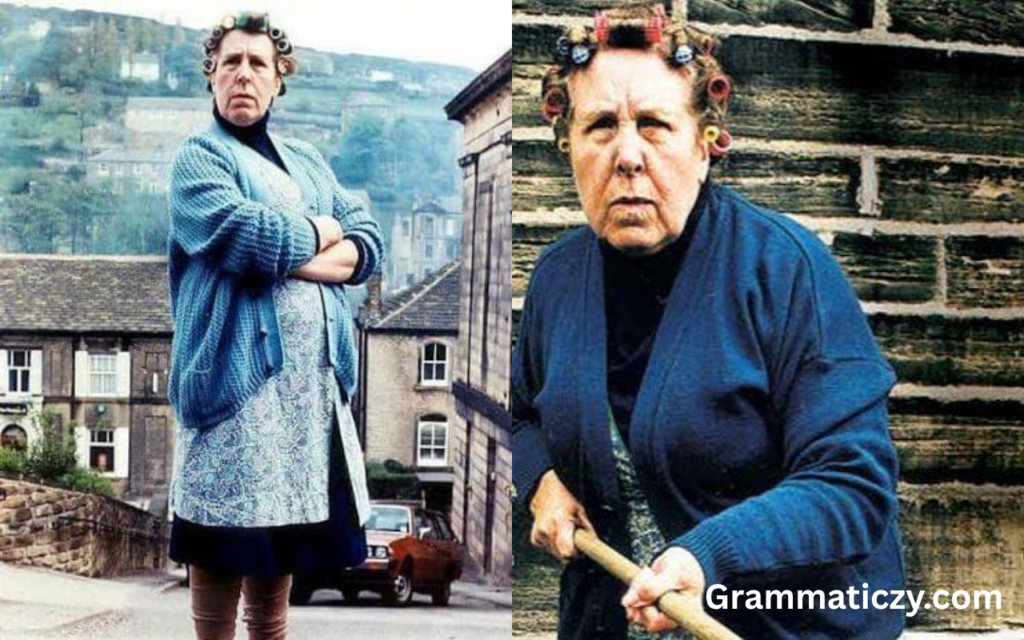
Few British television characters have ever achieved the instantly recognizable status of Nora Batty. With her distinctive hair curlers, apron, famously wrinkled stockings, stern expression, and legendary ability to silence foolish behavior with a single look, Nora became much more than a supporting character in Last of the Summer Wine. She developed into one of the most memorable personalities in British sitcom history. Although she was fictional, audiences came to know her as though she were a real neighbor from a Yorkshire town, someone whose opinions were strong, whose patience was limited, and whose presence could instantly change the mood of a scene.
Nora Batty was created by comedy writer Roy Clarke for Last of the Summer Wine, which first reached television audiences in 1973. She was portrayed by English actress Kathy Staff, whose performance transformed what might have been a relatively simple supporting role into an enduring cultural icon. Staff appeared as Nora across more than three decades and ultimately featured in 243 episodes of the long-running BBC sitcom. Her character became particularly famous for her relationship with Compo, played by Bill Owen, whose persistent attempts to impress Nora provided one of the show’s most recognizable running jokes.
The fascinating thing about Nora Batty is that her appeal did not depend on glamour, wealth, celebrity status, or an extraordinary fictional background. She represented something much more familiar: an ordinary woman with an extraordinary personality. Her domestic life, relationship with her husband Wally, battles with Compo, interactions with neighbors, and unmistakable northern character created a combination that audiences could immediately understand. Behind the comedy was also a surprisingly warm personality, something Kathy Staff herself emphasized when discussing the character. Staff believed Nora was fundamentally warm-hearted but reluctant to show her emotions.
Nora Batty Facts at a Glance
| Category | Information |
|---|---|
| Character Name | Nora Batty |
| Full Name | Nora Batty, née Renshaw |
| Character Type | Fictional television character |
| Created By | Roy Clarke |
| Television Series | Last of the Summer Wine |
| First Appearance | 1973 |
| Final Appearance | 2008 |
| Actress | Kathy Staff |
| Occupation | Housewife |
| Husband | Wally Batty |
| Brother | Billy Renshaw |
| Sisters | Madge Renshaw, Clara Renshaw and Stella |
| Famous For | Wrinkled stockings, hair curlers, apron and sharp personality |
| Main Romantic Pursuer | Compo, played by Bill Owen |
| Age | Never officially established |
| Birthplace | Not officially established for the character |
| Real-Life Actress | Kathy Staff |
| Kathy Staff Born | July 12, 1928 |
| Kathy Staff Died | December 13, 2008 |
| Character Net Worth | Not applicable |
| Official Social Media | None |
| Creator | Roy Clarke |
| Number of Episodes | 243 according to contemporary reporting |
Because Nora Batty is a fictional character, some categories commonly included in celebrity biographies simply do not apply. There is no verified birth date, real-world income, personal bank account, Instagram profile, LinkedIn page, or independently calculated net worth belonging to Nora. Her fictional family information identifies her as Nora Renshaw before marriage, with Wally Batty as her husband and several Renshaw relatives.
The real person behind the character was Kathy Staff, an English actress whose career extended well beyond Last of the Summer Wine. Staff was born Minnie Higginbottom in Dukinfield, Cheshire, in 1928 and worked professionally for decades across television, film, theatre, and other forms of entertainment. Her professional journey included appearances in Coronation Street, Crossroads, Open All Hours, Emmerdale Farm, and several films.
Who Was Nora Batty?
Nora Batty was introduced as a neighbor in the fictional Yorkshire world of Last of the Summer Wine. The sitcom centered on older characters who behaved with an enthusiasm that often seemed completely at odds with their age. Instead of presenting retirement as a quiet or uneventful period of life, Roy Clarke created a world where older residents could still be mischievous, romantic, competitive, argumentative, and determined to find amusement in everyday situations.
Nora was particularly important because she provided a strong counterbalance to the show’s eccentric male characters. While Compo and his friends frequently became involved in elaborate schemes, Nora represented order, domestic responsibility, and uncompromising common sense. She was often the person who reacted to their foolishness rather than participating in it. That contrast gave the comedy its rhythm and made her presence valuable even when she was not at the center of the storyline.
Over time, Nora became much more than simply Compo’s neighbor. Her distinctive appearance and personality turned her into a recognizable symbol of the sitcom itself. The Guardian described her as a formidable figure with heavily creased stockings and a readiness to reprimand anyone who behaved improperly, particularly Compo.
Nora Batty’s Early Story in Last of the Summer Wine
Nora Batty appeared from the beginning of Last of the Summer Wine. The character was already part of the show’s early concept, although her personality was not initially developed to the same extent that audiences would later know. Contemporary accounts explain that Nora was initially only lightly sketched, with Kathy Staff helping shape many of the details that eventually became central to her identity.
One of the most important elements of that transformation was Staff’s physical interpretation of the character. According to accounts of the show’s casting, Staff was initially not the obvious choice for the role because producers had envisioned Nora differently. She reportedly padded her clothing to make herself appear larger and then performed a scene opposite Bill Owen. That performance convinced the production team that she could bring the character to life.
The decision proved enormously successful. Nora’s appearance gradually became one of the most recognizable visual identities on British television. Her curlers, apron, practical clothing, and wrinkled stockings were not simply costume details; they became shorthand for the character. Once viewers saw that distinctive appearance, they immediately knew who was approaching and what kind of comic confrontation might follow.
Kathy Staff: The Actress Behind Nora Batty
Kathy Staff’s life story was considerably richer and more varied than Nora Batty’s fictional biography. Born Minnie Higginbottom, she developed an interest in performance from childhood and dreamed of becoming a ballet dancer. She performed in church activities and pantomimes before eventually finding her way into amateur theatre. Her first professional experiences came through repertory theatre, where she gained the practical skills that would later serve her throughout a long acting career.
Before becoming internationally recognizable as Nora Batty, Staff worked in a number of television productions and theatrical roles. She also spent approximately a decade away from acting while raising her family. Her return to professional television eventually led to more substantial opportunities, including roles in British soaps and comedy programs. This background is important because it shows that Nora Batty was not the product of an overnight success; Staff had already spent years developing her craft.
Her career included A Kind of Loving, The Dresser, Little Dorrit, and Mary Reilly, as well as television appearances in Coronation Street, Crossroads, Open All Hours, and other productions. Her autobiography, My Story – Wrinkles and All, was published in 1997.
Nora Batty and Compo’s Unforgettable Relationship
The relationship between Nora Batty and Compo became one of the defining comic partnerships in Last of the Summer Wine. Compo, played by Bill Owen, was openly fascinated by Nora and repeatedly tried to gain her attention. His romantic persistence was usually met with irritation, rejection, or a perfectly timed expression of disbelief from Nora.
The humor came from the enormous difference between Compo’s enthusiasm and Nora’s reaction. Compo could devise complicated schemes to impress her, while Nora generally seemed to regard him as an ongoing nuisance. His attempts ranged from ridiculous romantic gestures to elaborate plans designed simply to get closer to her. The Independent described Compo’s pursuit of Nora as a staple of the series, producing some of its most memorable storylines.
Despite the apparent hostility, their relationship became more affectionate and complicated over time. It was not a traditional romantic storyline, but it carried a strange familiarity. Compo had spent so long pursuing Nora that his interest became part of the landscape of her life. Nora’s resistance, meanwhile, became one of the most dependable sources of comedy in the series.
Nora Batty and Wally Batty
Nora’s husband, Wally Batty, provided an entirely different kind of relationship. Played by Joe Gladwin, Wally was portrayed as quiet, cautious, and frequently overwhelmed by his wife’s forceful personality. His domestic life contrasted sharply with Compo’s energetic attempts to win Nora’s affection.
Wally was often shown carrying out chores or trying to find small opportunities to escape the intensity of his home life. He also had interests of his own, including racing pigeons and a motorbike with a sidecar. These details helped prevent him from being nothing more than a comic victim of Nora’s temperament.
The character’s story changed after Joe Gladwin’s death in 1987. Wally subsequently died off-screen within the fictional world, leaving Nora as a widow. Even after his death, Wally continued to be referenced, demonstrating how established the Batty family had become within the show’s fictional community.
Nora Batty’s Personality and Hidden Warmth
At first glance, Nora Batty could easily be described as stern, intimidating, impatient, and occasionally frightening. She had little tolerance for foolishness and was especially unimpressed by Compo’s persistent romantic behavior. Her sharp tongue and physical reactions became essential parts of the show’s comedy.
However, Kathy Staff did not see Nora as simply an unpleasant woman. She believed there was warmth beneath the character’s hard exterior. Staff explained that Nora was the sort of woman who considered openly displaying emotions a weakness. That interpretation gave the character an emotional dimension that might otherwise have been missing.
This hidden tenderness is part of what makes Nora memorable. Viewers could laugh at her anger while still understanding that she was not simply cruel. She belonged to a generation and culture in which emotional restraint could be associated with strength. Her tough exterior therefore became part of her identity rather than evidence that she lacked affection.
Nora Batty’s Famous Appearance
The visual design of Nora Batty is arguably one of the greatest examples of costume becoming character. Her curlers immediately suggested that she was a practical woman concerned with her own domestic world rather than appearances. Her apron reinforced that impression, while the famous wrinkled stockings became perhaps the single most recognizable element of her appearance.
The stockings were especially important because they became part of the jokes surrounding Nora. Rather than hiding imperfections, the character’s appearance celebrated them. Her clothing was deliberately ordinary, and the visible wrinkles became a visual punchline that audiences quickly associated with her.
Kathy Staff’s performance made the costume even more effective. She did not merely wear Nora’s clothing; she moved differently because of the character. Her posture, facial expressions, gestures, and timing all contributed to the impression of a woman who had spent years dealing with people who tested her patience. The result was a character recognizable even from a distance.
Nora Batty’s Family Background
Nora Batty’s fictional family background was never explored in the exhaustive way a modern television drama might explore a character’s childhood. Viewers learned about her primarily through relationships and conversations rather than long flashbacks or detailed origin stories.
The character’s maiden name was Renshaw, and family references identify relatives including Billy Renshaw, Madge Renshaw, Clara Renshaw, and Stella. These details provide a small glimpse into Nora’s background, although the series never established a complete biography of her early childhood, schooling, or ambitions.
That limited background actually suited the style of Last of the Summer Wine. The program was less interested in explaining every detail of its characters and more interested in watching them interact. Nora did not need a complicated origin story because audiences understood her through her behavior. Her personality was her biography.
Nora Batty’s Career and Cultural Impact
Strictly speaking, Nora did not have a professional career. Her occupation was that of a housewife, and her fictional life revolved largely around domestic responsibilities, neighborhood relationships, and the everyday situations created by the people around her.
Her cultural impact, however, was enormous. Kathy Staff played Nora from the show’s beginning in 1973 until her final appearance in 2008. Contemporary reporting states that she appeared in 243 episodes, an extraordinary achievement for a television character.
Nora’s popularity also helped make Kathy Staff a recognizable television personality beyond the sitcom itself. The character’s success led to opportunities where Staff could draw upon her battleaxe image in other comedy productions, although she continued to demonstrate that she was a versatile performer rather than someone limited to a single role.
Kathy Staff’s Life Away From Nora Batty
One of the most interesting contrasts in this story is the difference between Kathy Staff and Nora Batty. Staff was reportedly much more elegant and gentle in her personal life than the character she portrayed. The Guardian noted that she enjoyed dressing elegantly and had a very different off-screen personality from Nora.
Staff was also deeply religious. Her faith was an important part of her personal life, and she maintained a connection with her local church. This was another significant contrast with the public image of Nora Batty, whose television identity was built around domestic arguments, sharp remarks, and comic confrontations.
She married John Staff and had two daughters. Her decision to step away from acting for a period to raise her family demonstrates that her life was shaped by responsibilities outside entertainment as well as by her professional ambitions. When she returned to acting, she gradually rebuilt her career and eventually reached the role that would define her legacy.
Nora Batty’s Final Television Years
Nora Batty remained part of Last of the Summer Wine through its later years. Kathy Staff briefly left the series in the early 2000s but eventually returned, continuing to portray Nora until the character’s final appearance in 2008.
Staff’s last appearance as Nora came in August 2008, near the end of the show’s 29th series. The BBC and contemporary obituaries reported that she had been unable to continue because of illness.
Kathy Staff died in December 2008 at the age of 80. Her death brought an emotional end to the career of an actress who had spent more than three decades associated with one of British television’s most recognizable characters. Tributes from colleagues and friends emphasized both her professional achievements and her warmth away from the screen.
Nora Batty’s Net Worth and Income
Because Nora Batty is fictional, it would be misleading to assign her a real net worth. She did not earn television salaries, own investments, operate businesses, or maintain personal bank accounts. Any online figure presented as “Nora Batty’s net worth” should therefore be understood as speculation or a misunderstanding of the character.
The financial story that can be discussed responsibly concerns Kathy Staff. She earned income through a long acting career spanning television, film, theatre, and other professional work. Her credits included major British television productions and feature films, but reliable public sources do not provide a definitive figure that can be presented as her exact personal net worth.
For SEO purposes, this distinction is particularly important. Searches for “Nora Batty net worth” may produce pages that invent a specific number, but there is no factual basis for claiming that Nora herself had a particular fortune. A trustworthy biography should explain the distinction rather than repeat unsupported celebrity-net-worth estimates.
Nora Batty and Social Media
Nora Batty never had personal social-media accounts because the character originated decades before Instagram, Twitter/X, Facebook, and other modern platforms existed. There is therefore no authentic Nora Batty Instagram, LinkedIn, or Twitter account that can be identified as belonging to the character.
Today, fans can find discussions, photographs, video clips, memorabilia, and tribute material related to Last of the Summer Wine online. Some fan pages may use Nora’s name or image, but those accounts should not be confused with official accounts operated by the fictional character.
The lack of social media also highlights how dramatically television culture has changed. Nora Batty became famous without posting a single selfie, writing a social-media update, or interacting with fans online. Her popularity was created entirely through television broadcasting, repeat screenings, newspapers, radio discussions, and word of mouth.
Why Nora Batty Remains Popular
Nora Batty remains popular because her personality is immediately understandable. She is the kind of character whose reaction often becomes the joke. Before she says anything, viewers can anticipate the look on her face when Compo appears with another ridiculous scheme.
Her humor is also rooted in ordinary life. There are no superheroes, elaborate fantasy worlds, or expensive action sequences involved. The comedy comes from neighbors, relationships, domestic routines, misunderstandings, romantic embarrassment, and the clash between different personalities.
That simplicity gives the character a timeless quality. Even as television comedy has changed dramatically, audiences can still understand Nora’s frustration with annoying neighbors, unwanted attention, and people who refuse to behave sensibly. Her world may belong to another era, but the basic human emotions remain recognizable.
The Legacy of Kathy Staff and Nora Batty
Kathy Staff’s greatest achievement was turning Nora Batty into a character who could survive beyond individual jokes. Staff’s performance was consistent enough to make Nora recognizable but flexible enough to allow the character to evolve as the series changed around her.
Her longevity is particularly impressive because Last of the Summer Wine itself went through enormous changes. Cast members came and went, storylines evolved, and the show’s tone gradually shifted from sharper comedy toward gentler, more affectionate humor. Yet Nora remained an identifiable force throughout much of the show’s history.
The character’s legacy is therefore shared between writer, actress, fellow performers, and audiences. Roy Clarke created the world and the character, Kathy Staff gave Nora her voice and physical identity, Bill Owen provided the unforgettable Compo dynamic, and viewers turned the character into a cultural icon through decades of affection.
Conclusion: The Enduring Story of Nora Batty
Nora Batty’s story is ultimately a reminder that unforgettable television characters do not need extraordinary lives. Nora was a fictional housewife from Yorkshire, yet her personality became powerful enough to make her one of Britain’s most recognizable sitcom figures. Her curlers, apron, wrinkled stockings, sharp tongue, and legendary relationship with Compo remain instantly associated with Last of the Summer Wine.
The achievement becomes even more remarkable when Kathy Staff’s contribution is considered. She took a relatively lightly sketched character and developed her into someone with personality, humor, vulnerability, authority, and hidden warmth. Staff understood that Nora should not simply be angry; she should feel like a real woman whose toughness had developed through life. That understanding helped sustain the character for more than 30 years.
Today, Nora Batty remains a symbol of classic British sitcom comedy and of an era when television could build lasting cultural icons from ordinary people and everyday situations. Her story is not about wealth or celebrity status but about character, consistency, humor, and the extraordinary impact of a great performance. As new audiences continue to discover Last of the Summer Wine, Nora Batty’s legacy demonstrates that a memorable personality can outlive its original era—and that sometimes the most ordinary characters are the ones who leave the most extraordinary impression